Give the Gift of Play —and Language!
As parents, we love finding that perfect toy for the holidays. Something that will bring joy and excitement and hopefully hours of entertainment. When those toys can also support learning, that’s a true win. Some of the most powerful tools for speech and language development are simple, timeless classic toys that invite imagination, storytelling, and connection.
As a Speech-Language Pathologist supporting young children at home and at school, I spend my days playing with toys to support engagement, social development, and speech and language. I’ve selected my top five expert-approved toys that help children talk, think, and play their way toward stronger communication skills.
1. Critter Clinic
“Open, close, feed, fix — every pretend pet visit builds new words!”
This adorable vet-themed play set encourages rich vocabulary and social interaction. As your child cares for the animals, unlocking doors, checking heartbeats, or feeding the puppy, they’re learning words for animals, actions, colors, and body parts. Pretend play also strengthens sequencing and storytelling, essential early language skills. Your child will love hiding all sorts of toys behind the locking doors. This toy is so versatile, as it easily transforms from vet clinic, to car garage, to apartment building, to mini school with the turn of a key and a bit of imagination.
2. Dress-Up Clothes
“When children pretend, language ignites”
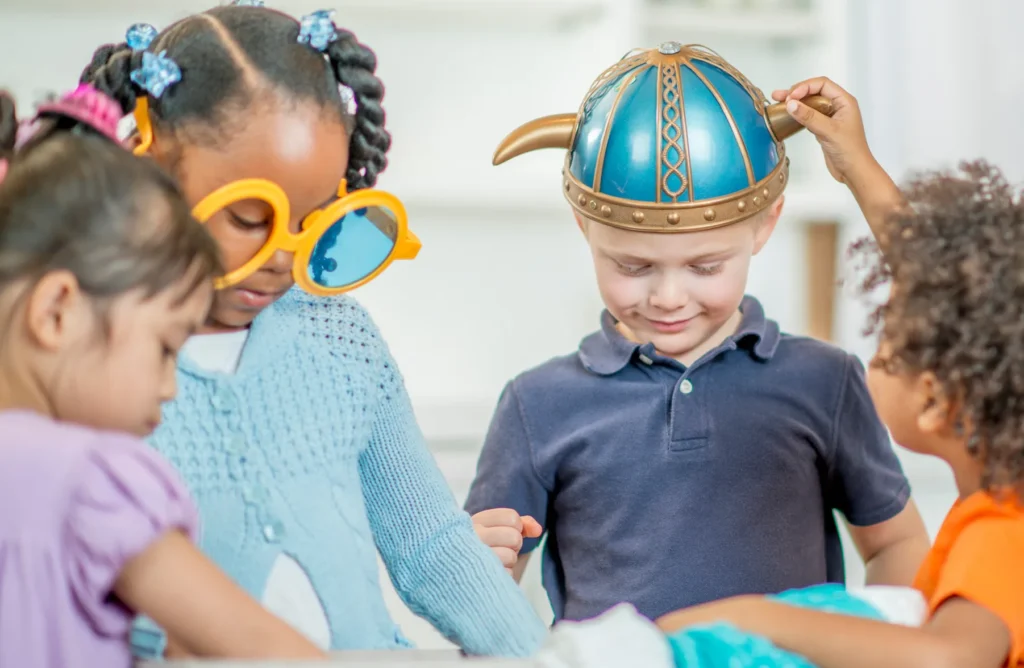
From superheroes to doctors, dress-up play allows children to explore roles and experiment with expressive language. Encourage your child to describe what they’re doing (“I’m the teacher today!”) and narrate stories as they unfold. Joining in their pretend world lets you model new words and expand on their ideas naturally. Your child will love watching you dress up and be silly, and their language will grow by listening to you talk and play.
3. Playmobil and Little People Sets
“The Little People in these sets support BIG opportunities for language development”
These open-ended toys are perfect for building imagination and sentence structure. Whether setting up a zoo, home, or city scene, your child practices storytelling, problem-solving, and perspective-taking. They will also develop their use of grammar (such as ‘he, she, they’) and prepositions (such as ‘in, on, beside’) by talking
about what the boys and girls are doing as they set up their play scene. Try prompting with questions like, “What happens next?” or “Who’s visiting the farm today?” or “Where is the dog hiding?” to keep the conversation growing.
4. Mr. Potato Head Family
“This beloved classic never goes out of style!”
When playing with this adorable toy, children learn about body parts, adjectives, and directions as they build silly or realistic Potato Head characters. Encourage descriptive language while playing- “This one has big eyes and a tiny hat!”. You can practice turn taking and requesting skills with your child by having them ask you for what they would like next- “Can I have the blue shoes?”.
5. Guess Who?
“A game of questions, clues, and conversation.”
This family favorite builds reasoning and vocabulary while teaching kids to form clear, descriptive questions. “Does your person have glasses?” or “Is it a girl?” helps children organize thoughts, use categories, ask questions with correct grammar, and practice turn-taking. It’s a great language workout disguised as family fun. This game is a hit with older kids and is one of my most requested games in my therapy room.
The Gift of Connection
The best toy for speech and language growth isn’t necessarily the most expensive one, it’s the one that brings you and your child together. Talking, laughing, and pretending together builds not just language, but connection, confidence, and creativity.