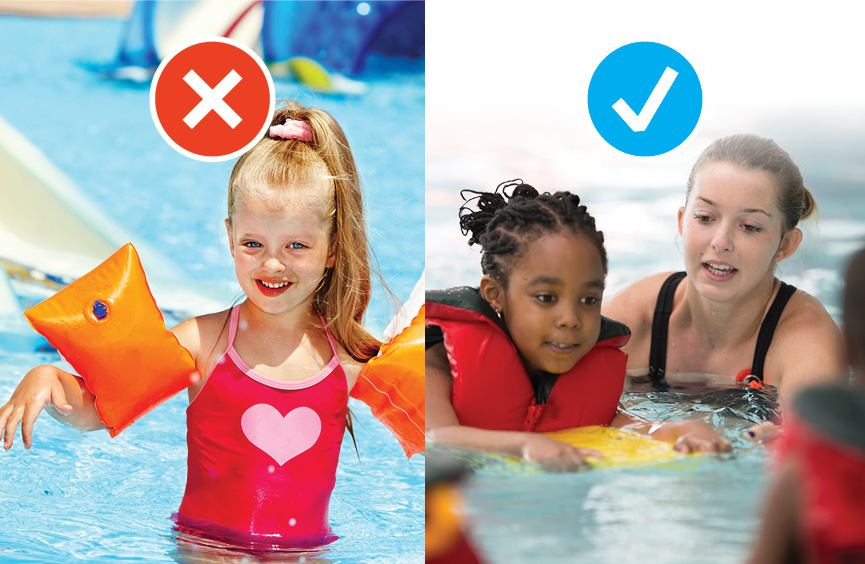
When you go to the beach or pool this summer, it is important to think about water safety for young children. My advice is simple: do not use arm floaties (also called water wings). They are toys, not safety devices, and they should not be trusted to keep a child safe in the water. They can slip off, lose air, or break. They can also make children and adults feel safer than they really are. To make water time safer, focus on what works best: close supervision, a lifejacket or personal flotation device (PFD) that fits well when needed, and swim lessons to build real skills.
“When I think about keeping children safe around water,
I think about safety in layers.”
Many parents also ask about puddle jumpers. These are flotation aids with arm pieces joined to a band around the chest. I understand why parents may think they are a better choice than arm floaties. They may seem stronger and safer. But if the goal is to help a child learn to swim, they are still not the best option. These aids usually keep children in an upright position in the water and can make it harder for them to move their arms naturally. Real swim skills come from learning how to float, kick, reach, roll, and move through the water in a natural way. Puddle jumpers can also make children and adults feel more confident than they should, and this is a problem. People start to think the device replaces supervision or real swim ability.
When I think about keeping children safe around water, I think about safety in layers.
The first and most important layer is active supervision. Always keep young children close enough to reach you with their arm. Do not get distracted by your phone, social media, or anything else. Do not walk away, even for a moment.
The second layer is a lifejacket or PFD that fits properly and is approved by Transport Canada. This is especially important near lakes, docks, boats, and other open water.
The third layer is swim lessons. Swim lessons help children feel more comfortable in the water, build confidence, and learn real skills over time.
No single layer is enough by itself. But together, close supervision, the right equipment, and swim lessons can help make summer around water safer and more enjoyable for everyone.